Upper back & shoulders
Upper back and shoulder pain relief
That tight band across the shoulder blades, the knot at the top of the traps, the ache that gets worse the longer you look at a screen — this is the most common pattern we hear about from UK desk workers and phone users, and it responds well to the right combination of posture changes and targeted heat.
4.8/5from 2,841 UK customers
Written by The Orevive UK care teamLast reviewed August 2026How we write this, and what is not medical advice
The short answer
Upper back and shoulder tension is almost always muscular, built up from hours in a forward-head, rounded-shoulder posture at a desk or over a phone. Regular movement breaks plus 10–15 minutes of heat and kneading across the trapezius and rhomboids loosens it far faster than stretching alone — the Orevive SpineEase does exactly this from £79.95, with a 30-day money-back guarantee if it doesn't help.
Why the upper back takes the strain
Your head weighs around five kilograms when it sits directly over your spine. Every inch it tips forward towards a screen or a phone multiplies the effective load the neck and upper back muscles have to hold against gravity. Over a working day, the trapezius, rhomboids and levator scapulae — the muscles running from your skull down across your shoulder blades — end up doing isometric work for hours on end. Muscles held in one position without rest don't get a chance to flush out and recover, which is why the same spot between the shoulder blades tends to flare up by mid-afternoon.
This is different from lower back pain, which is more often about load through the discs and joints. If your ache sits mainly across the shoulders and upper back, read on here; for the lower back specifically our general UK back pain guide covers more ground.
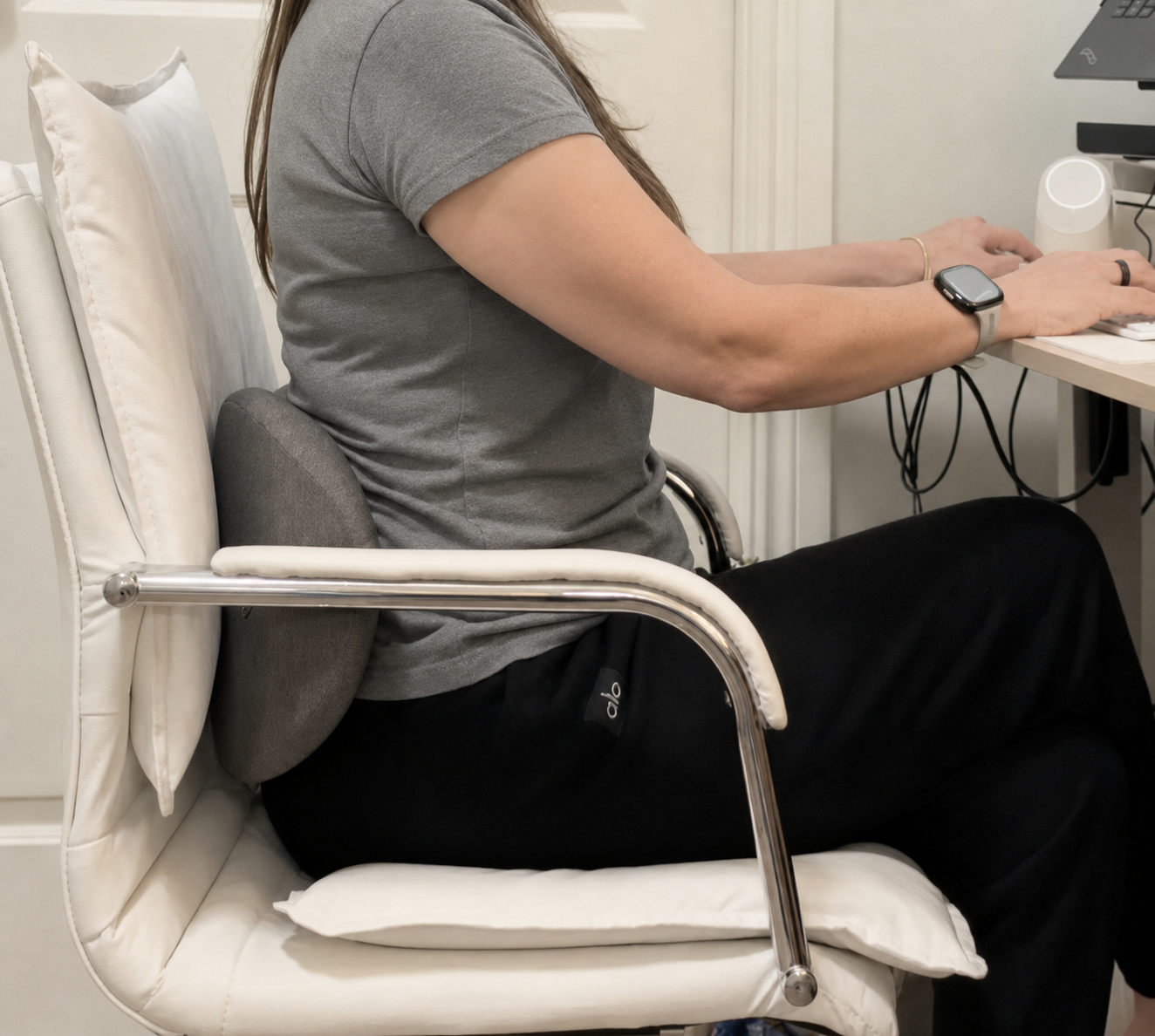
Desks, laptops and "text neck" posture
Most UK offices and home setups make this worse without anyone noticing. Laptops sit low, so the head tilts down. Monitors are pushed to the back of the desk, so people lean forward to read small text. Phones are held in the lap rather than at eye level, which is the single biggest contributor to the pattern often called "text neck", although the strain lands squarely across the upper back too.
- Raise a laptop on a stand and use a separate keyboard and mouse if you use one for more than an hour a day
- Bring the monitor closer and raise the top of the screen to eye level
- Hold your phone up in front of your face rather than reading it in your lap
- Rest your forearms on the desk or armrests so your shoulders can drop away from your ears
- Keep your mouse close enough that you are not reaching and rotating your shoulder repeatedly
The commute and the sofa count too
It isn't only the working day. Scrolling on a train or bus with your neck bent forward, slouching into a sofa with your shoulders rounded, or carrying a heavy bag on one shoulder every day all add to the same load. If you drive as part of your commute, our guide for drivers covers seat setup that also helps the upper back. Swapping a one-shoulder bag for a rucksack, and consciously sitting back into a sofa with support behind your upper back rather than perched forward, both make a real difference over weeks.
Movement breaks that actually work
Stretching once in the evening rarely undoes eight hours of static loading. What tends to work better is short, frequent movement through the day:
- Stand up and roll your shoulders backwards ten times, every 30 minutes
- Squeeze your shoulder blades together and hold for five seconds, five repetitions
- Doorway chest stretch, 20 seconds each side, to counter rounded shoulders
- Chin tucks — gently draw your chin back level, ten repetitions — to reset a forward head
- A two-minute walk away from the desk whenever you finish a call
Where heat and kneading fit in
Stretching lengthens a muscle briefly; heat and massage help it actually let go. The Orevive SpineEase combines 42°C infrared heat with EMS pulses and deep kneading vibration in one cordless unit, and although it's built with the lower back in mind, a great many customers use it positioned high across the upper back and shoulder blades for exactly this kind of tension. Fifteen minutes with heat and kneading while you sit watching television in the evening is, for most people, the point where the knot finally softens rather than just being stretched around.
If you specifically want a neck-focused product, our neck pain relief device guide explains the difference and where the caution points are around the cervical spine.
Sleep position and pillows
A pillow that's too high or too flat tips the neck out of line all night, which shows up as upper back stiffness the next morning. Side sleepers generally need a firmer, higher pillow to keep the neck level with the spine; back sleepers usually need something thinner. If you wake up with the same tight spot every single morning regardless of what you did the day before, your pillow and mattress are worth reviewing before anything else.
When it's more than muscular tension
Most upper back and shoulder pain from desk work and phone use is straightforwardly muscular and improves with the changes above. It's worth being cautious, though, and seeing a GP or physiotherapist if pain is one-sided and worsening, radiates down an arm with numbness or weakness, follows a fall or impact, or is accompanied by fever, unexplained weight loss or night sweats — these are not typical desk-related patterns.
Order the official Orevive SpineEase
Tracked UK delivery, 30 days to change your mind, and a manufacturer warranty.
£79.95single unit · 2x Orevive SpineEase £143.90
See bundles and orderBuilding a routine that sticks
The people who get lasting relief tend to combine three things: a desk and phone setup that stops making it worse, short movement breaks through the day, and a proper 15-minute wind-down with heat in the evening. None of these alone is usually enough on its own — the posture fixes stop new tension building up, and the heat and kneading session deals with what's already there.
Tracked UK delivery, dispatched from a UK warehouse
30-day money-back guarantee, no restocking fee
manufacturer warranty and UK-based support
Official store — genuine unit, not a marketplace copy
Safety, contraindications and when to see a GP
- Do not use if you have a pacemaker or any implanted electronic device
- Do not use during pregnancy, over broken skin, or on numb areas
- Speak to your GP or physiotherapist first after spinal surgery or a recent injury
- Seek urgent care for numbness around the groin, loss of bladder or bowel control, weakness in both legs, unexplained weight loss or fever with back pain
- Keep intensity low on the upper trapezius and stop immediately if you feel light-headed
Questions people ask us about this
Why does my upper back hurt more by the end of the working day?
Muscles held statically to support a forward head posture fatigue over the course of the day without proper breaks. The ache typically builds through the afternoon and eases overnight, which is a classic sign it's muscular rather than structural.
Is it my desk chair or my monitor causing this?
Often both, but a monitor that's too low is the more common culprit for upper back and shoulder tension specifically, since it drives the head-forward posture. Check the monitor height before replacing the chair.
Can phone use really cause upper back pain?
Yes. Looking down at a phone held in your lap for long periods loads the same muscles as a low monitor, and most people do it far more often through the day than they realise.
How is this different from neck pain?
They overlap and often occur together, but upper back and shoulder pain sits more across the shoulder blades and trapezius, while neck pain is more localised to the cervical spine. Our neck pain guide covers the neck-specific caution points.
How long before I notice a difference?
Many people feel the muscles loosen within the first session. Lasting change tends to take a few weeks of combining desk changes, movement breaks and regular evening sessions.
Can I use the SpineEase on my shoulders as well as my back?
Yes, many customers position it across the upper back and top of the shoulders. Keep the intensity lower there than you might use on the lower back, as the muscle is thinner.
Should I stretch or use heat first?
Heat first tends to work better, since it helps the muscle relax before you ask it to lengthen. A short stretch afterwards can help maintain the range you've gained.
Sources and further reading
We link to NHS and other public guidance so you can check anything on this page for yourself. Orevive SpineEase is a wellness device, not a medical treatment.
Keep reading
Ease the knot between your shoulder blades
Order the official Orevive SpineEase with tracked UK delivery and 30 days to change your mind.
30-day money-back guarantee · Secure Shopify checkout · Tracked UK delivery
Compare all three bundles first